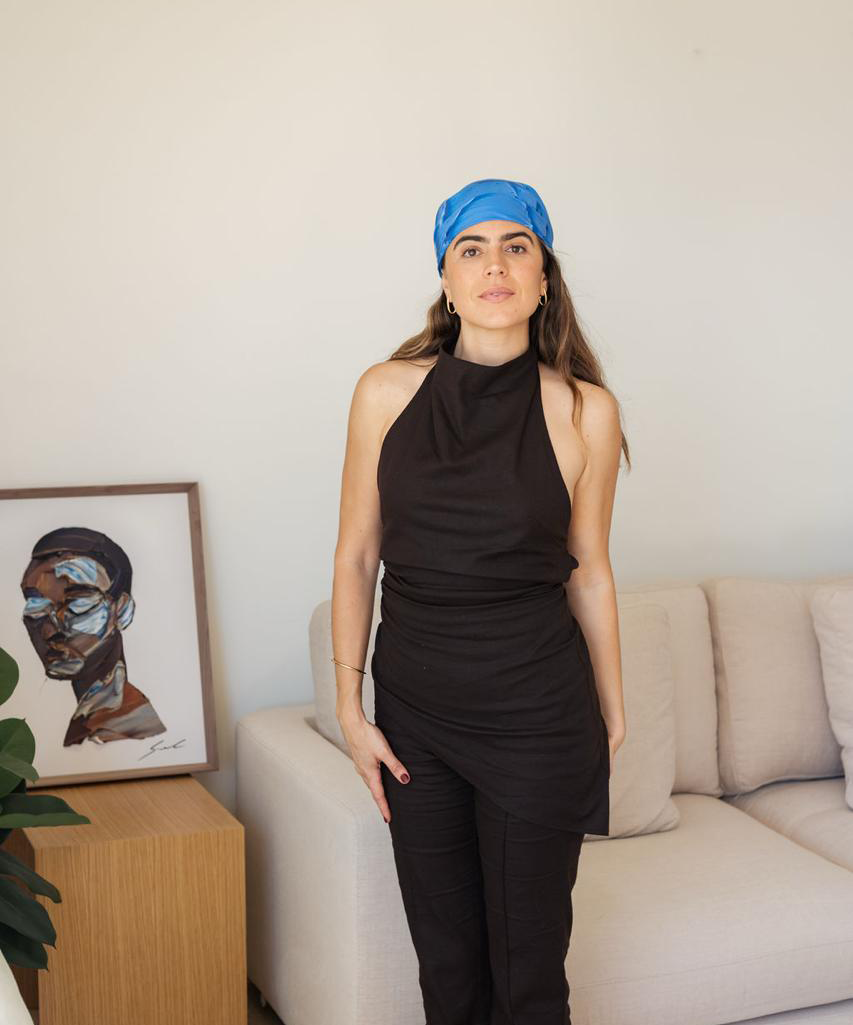
Carla Cascales: “For me, concepts such as beauty or balance are fundamental, even if socially they are seen as minor or superficial”

Carla Cascales Alimbau (Barcelona, 1993) is a sculptor and visual artist whose practice emphasises process and direct contact with matter. Her work, linked to the body, care and the idea of fragility, takes shape in sculptures and installations where the handmade and the contemporary coexist. Through materials such as ceramic, plaster or metal, Cascales explores intimacy, time and the emotional imprint of objects. From her studio and through social media — which she uses as an extension of the workshop — she shares an honest view of artistic making and the process behind each work, bringing contemporary sculpture closer to audiences who do not always engage with art through traditional codes.


01. Your work grows out of process and direct contact with materials. Which part of that time of observation and experimentation do you consider essential to preserve today?
My work comes from a slow, non-academic time, very far removed from a purely intellectual process. That is why, for me, it is essential to preserve a space for observation and experimentation that acts as a form of protection against constant acceleration. I begin without really knowing where I am going, trying out different materials and allowing them to show me the way. There is a lot of trial and error, of listening and paying attention to what is happening. I need to work with a very open mind, without a fixed outcome, and although that sometimes involves uncertainty, it is also what makes the process exciting and alive.

02. Ideas such as care, vulnerability or bodily memory appear in your sculptures. Where do these concepts come from?
I am increasingly aware that we live trapped in mental processes, and that if there is one thing that makes us unique in this earthly experience, it is the body. My work emerges from that place: from the need to return to the body as a site of knowledge and memory. I am interested in shaping material through bodily gesture, working with imperfection, scars, fluidity and vulnerability. Concepts such as care or memory appear organically, because they are linked to that direct physical experience, to what is held, adapted or transformed. The body not as an ideal, but as a sensitive and changing territory.


03. You use Instagram almost as an open working notebook. What does sharing the process —and not just the result— of your artistic production give you?
Instagram works for me as a work diary, a place to note down what appears and what does not, opening a window onto a creative process that usually remains hidden. I also use it to share everything that inspires me: exhibitions I visit, nature, books… Now, with the move to a new studio, I also feel like sharing the process of transforming an industrial warehouse into my workspace, but doing so in a poetic and not overly obvious way, almost abstract. I am interested in maintaining that balance between showing the process and preserving an intimate, personal space outside social media.


04. Many of your works are based on small gestures and contained formats. How do you decide when a piece should remain at that intimate scale and when it should grow and engage with space?
The scale of the works is closely linked to the space in which they are made. For a long time, I worked in small studios, which meant my work was contained and more intimate. I have always had the desire to work on a larger scale, but I could not do so for spatial reasons. Now, with the move to a new studio, I feel the space will be able to accommodate larger works, and that excites me enormously. I want to allow myself to be surprised by what might happen, to see how the space itself influences the pieces and to discover what new works can emerge from that sense of openness.


05. You have developed projects that engage with very different contexts, from galleries to spaces linked to gastronomy. One of your works presides over Casa Pisco, a single-family home. What inspired you when creating it?
Whenever I have felt connected to a project, collaboration has come very naturally to me. I like art to have a life, to exist in a home, in a place where things happen and where people are present. I conceive sculpture as something that can be lived with, and also as something that adds value to a space, not only aesthetically but emotionally as well.
In the case of the work for Casa Pisco, the idea was to bring a small fragment of the Mediterranean into the house, almost as if you took a bowl and carried a little seawater with you. It is a tiny piece, but I think of it as a little window looking out onto the sea, a horizon that suddenly appears. I particularly liked the fact that it can be seen from the entrance; that when you walk into the house, you encounter the sea at the back, with that sense of openness and calm.


06. Your work connects with audiences who do not always approach art from an academic perspective. Do you think the way contemporary sculpture is viewed, understood and legitimised by a more general audience is changing?
My work has always been very sensorial. For me, concepts such as beauty or balance are fundamental, even though socially they are sometimes considered minor or superficial because they are associated with aesthetics. And yet, allowing oneself to be surprised by the beauty of nature or of everyday things seems to me profoundly important.
I like the idea that my work can be understood and enjoyed by people of any age, background or context, without the need for prior academic training. The work can connect in a visceral, direct way, without it being essential to understand all the concepts that run through it. From there, anyone who wants to delve deeper can do so, because I do accompany the pieces with more theoretical texts and reflections. But I am very interested in that first intuitive, almost bodily connection.


07. Finally, at this point in your career, which new paths are you interested in exploring?
At this moment in my career, I am at a fascinating point. I have managed to find what feels like my dream studio, and I am now fully immersed in the renovation process to turn it into an open, living space. It is a former industrial warehouse from 1932, with nine-metre-high ceilings, which will allow me to work with hanging sculptures and at a scale I have not been able to explore until now.
My wish is for it to be a place where other artists can come, where encounters and collaborations with people from different disciplines can take place. At the moment, I am particularly fascinated by the world of dance, and I would love the studio to host everything from music to movement. I also want it to be a place that people who connect with my work can visit, to see the work slowly and really experience it. It is a new process and a significant challenge, because I have never taken on a renovation of this scale before, but I am working with an incredible professional and friend, Sheila Llovet, and I feel very supported. It is a project that moves me deeply and that I feel marks the beginning of a new stage.